September eNews
Welcome to this month's news round up.
Our top five stories explore some fascinating questions and innovative solutions: what is absorbing light in Venus’s atmosphere? How much ice is stored in the world’s glaciers? Could cooling ceramics help cities tackle rising temperatures? Can famine be predicted before it takes hold? And could geothermal energy help us prevent potholes before they form?
We also highlight a remarkable new development in soft robotics: light-powered robots that can keep jumping for as long as they are illuminated. And, for our Image of the Month, we turn to the intricate relationship between plants and pollinators, exploring how tiny scoop-shaped structures in flowers help control the release of pollen.
If you would like to get in touch with the News Team, please email news@alphagalileo.org
All the best,
AlphaGalileo News Team
Top 5
1. Venus’s Mysterious Clouds May Hide an Exceptionally Strong Light Absorber, published by the Institute for Basic Science on 27/08/26
Venus appears pale yellow in visible light, but ultraviolet images reveal dramatic dark and bright patterns moving with the planet’s upper sulfuric acid clouds. Scientists have known about these markings for roughly a century, yet the chemical identity of the material responsible—the “unknown absorber”—remains unresolved.
An international research team has now placed new quantitative constraints on the properties of this mysterious absorber. By combining observations of Venus with radiative-transfer modeling, the researchers estimated how strongly the liquid inside Venus’s cloud droplets would need to absorb light to reproduce the planet’s observed ultraviolet and blue reflectance.
Read the news
2. A New AI Model Reveals The Volume Of The World's Glaciers, published by Ca’Foscari University of Venice on 07/08/26
A study led by Ca’Foscari University of Venice in collaboration with CNR-ISP and published in Scientific Data (Nature) presents IceBoost v2.0. Trained on more than 7 million measurements, the model reconstructs the volume and spatial distribution of ice across all glaciers worldwide. A web app enables users to visually explore data from every glacier on Earth.
Read the news
3. TU Graz Develops a Cooling Ceramic Wall to Combat Urban Heat, published by TU Graz on 04/08/26
Porous ceramic cubes produced by a 3D printer utilise energy-efficient evaporative cooling and significantly lower the temperature. A prototype of the cooling wall made from ceramic cubes is already on display on the TU Graz campus.
Read the news
4. Predicting the Conditions That Create Famine, published by Tufts University on 12/08/26
A collection of new studies from researchers at Tufts University and institutions spanning academia, humanitarian organizations, global development, and data science suggest that famine is not a sudden event, but rather a complex system that evolves—and may be interrupted.
Read the news
5. Could geothermal roads help prevent potholes before they form? Surrey trial aims to find out, published by the University of Surrey on 13/08/26
The UK's pothole problem could one day be tackled from beneath the road surface, as researchers at the University of Surrey launch a pioneering trial that uses heat stored underground to keep roads cooler in summer, warmer in winter and less prone to damage.
Read the news
News Team's choice
Light-Powered Soft Robots Can Keep Jumping Forever, published by North Carolina State University on 28/08/2026
Researchers from North Carolina State University have created teardrop-shaped soft robots that leap upward or forward when exposed to infrared light – and will keep jumping as long as the light is present. The work demonstrates a new mechanism for self-resetting jumping behavior in soft robotics.
Read the news
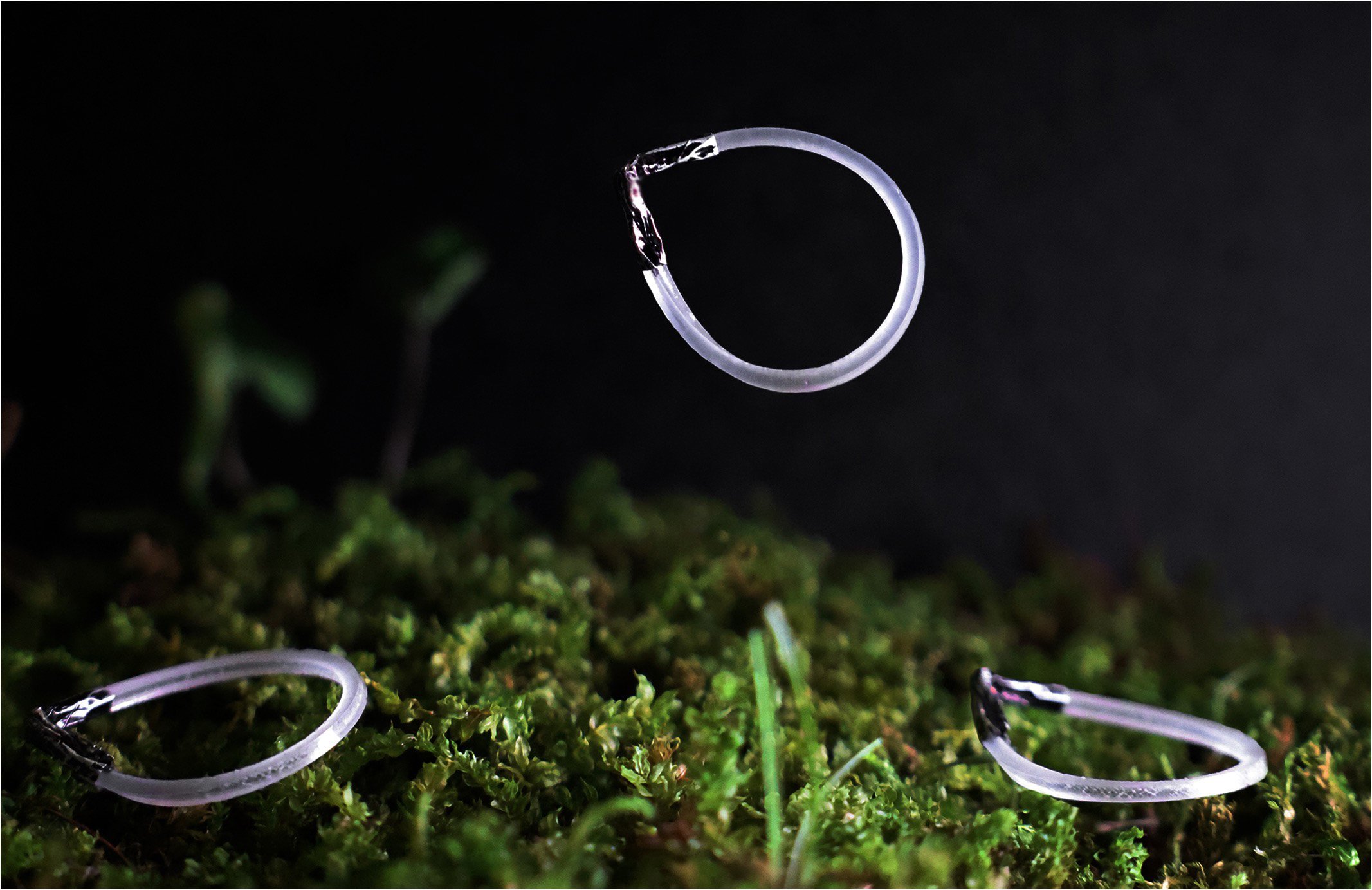
Image caption: Photo credit: Fangjie Qi, NC State University.
Image of the month
How plants use scoop-shaped pores to distribute their pollen efficiently, published by University of Vienna on 26/08/2026
Approximately 30,000 species of flowering plants have "poricidal anthers" from which pollen can only be released when bees apply mechanical vibrations to them. In a new study recently published in Nature Communications, a research team at the Department of Botany and Biodiversity Research at the University of Vienna found that the shape of the plant's anther pore determines how pollen is released. The scientists discovered that anthers bearing scoops around their pores expel their pollen in narrower, more targeted jets than anthers lacking such scoops, which normally scatter pollen in broad clouds. Furthermore, scoop-bearing anthers release pollen at faster speeds. The team further learned that scoop-shaped pores are sensitive in their functionality to the exact nature of the vibration applied. Findings such as these are particularly important in light of more frequent temperature extremes altering flower vibrational properties, and declines in bee abundance and diversity.
Read the news
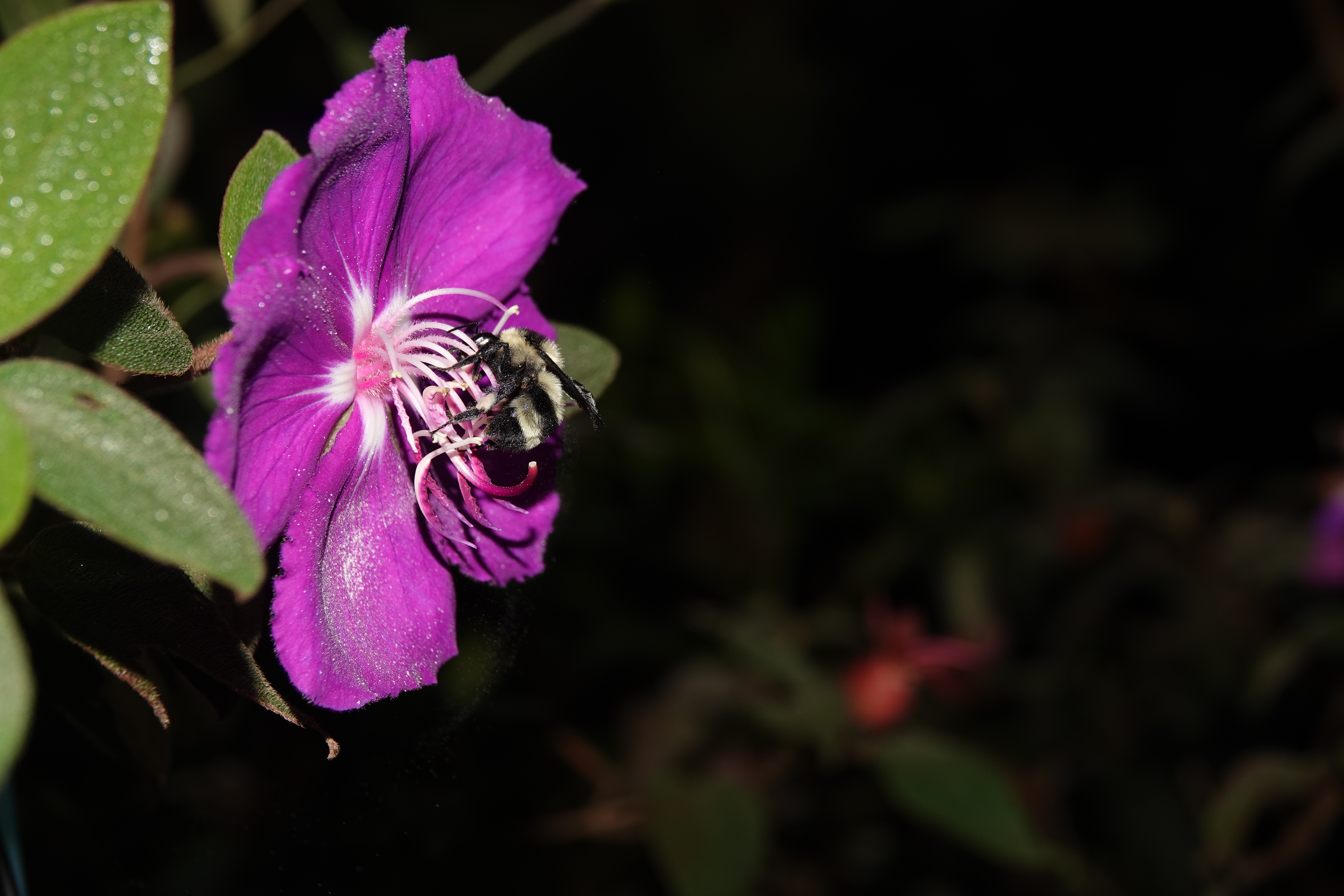
Image caption: Bee buzzing poricidal stamens of Pleroma (Melastomataceae), pollen grains are visible as white dust on the pink petals below the bee. C: César Arvelos