July eNews
In this edition, we reflect on another exciting month of discovery, innovation and impactful research stories from across the global science community.
We were delighted to once again support the ABSW Awards as media partner, celebrating the outstanding achievements of science communicators and journalists. Congratulations to all the nominees and winners for their dedication to sharing research that informs, inspires and connects with audiences.
Inside this months enews, we bring you the five most-read stories from June, highlighting groundbreaking work spanning architecture, archaeology, nutrition, advanced technologies and ocean exploration. From new insights into the women who shaped the modern built environment to pioneering developments in robotics and healthcare, these stories showcase the breadth and creativity of today’s research landscape.
We also feature our News Team’s Choice and Image of the Month — two fascinating stories demonstrating how scientific curiosity continues to reveal new possibilities, from improving our understanding of human health to uncovering the hidden processes behind social behaviour.
We hope you enjoy this month’s selection of news and discoveries.
If you would like to get in touch with the News Team, please email news@alphagalileo.org
All the best,
AlphaGalileo News Team
Top 5
Catch up on the 5 biggest news stories everyone was reading in June.
1. New book challenges history, revealing how women shaped the modern built world, published by UCD Research and Innovation on 11/06
Groundbreaking book rewrites the narrative of modern architecture and design by shining a spotlight on the powerful global impact of women entrepreneurs, arising from the ‘Expanding Agency’ ERC project led by Prof Kathleen James-Chakraborty.
Read the news
2. Goosebump Moments in Archaeological Research, published by the University of Bonn on 12/06
How did people live centuries ago? How did they see themselves? How were they perceived by others? Today, archaeology uses modern methods to examine skeletons, personal belongings, burial practices, material culture and social and spatial relationships. The book “Human Identities in the Archaeological Record: Interdisciplinary Perspectives from Late Antiquity to the Modern Period” shows how past identities can be reconstructed from this evidence.
Read the news
3. Thrifty Food Plan Costs Vary Widely Across US Regions and Cities, published by Elsevier on 08/06
A recent study in the Journal of Nutrition Education and Behavior (JNEB), published by Elsevier, examined how the cost of the USDA’s Thrifty Food Plan (TFP), which serves as the basis for determining maximum SNAP benefits, varied across geographic regions, metropolitan areas, and seasons from 2012 to 2018. Researchers found that where a household is located plays a much larger role in the cost of a healthy diet than year-to-year inflation.
Read the news
4. A Breakthrough Concept in Nano-Printing Technology, published by KAIST on 15/06
A breakthrough technology has been developed that allows metal circuits floating on water to be transferred directly onto any desired surface. A South Korean research team has introduced a novel technique capable of transferring ultra-fine nano-circuits onto plant leaves and fruits, as well as curved automotive surfaces and robot exteriors, all without causing any damage. This technology is expected to be widely utilized across various cutting-edge industries, including smart agriculture, wearable healthcare, and bioelectronics.
Read the news
5. Underwater robots that are always on call, published by The Norwegian University of Science and Technology (NTNU) on 18/06
More than 70 per cent of the Earth is covered by oceans. An increasing amount of critical infrastructure is being installed on the seabed. Sabotage and accidents increase the need for inspection and monitoring. These measures are currently very expensive, but the hope is that they can soon be carried out by robots that are permanently stationed on the seabed.
Read the news
News Team's Choice
Mini monitor measures artificial heartbeat: Fish inspires new sensor which can monitor how human heart tissue responds to disease and treatment, published by University of Tokyo on 29/06
An international team, including the University of Tokyo, has created a sensor inspired by the lateral line in fish – their “sixth sense” organ – which measures the pulse of lab-grown 3D heart tissue (cardiac organoids). The device, called a biomechanical well plate, looks like a small white box containing four liquid-filled wells. When an organoid is placed in a well, each beat causes the liquid to bulge into an air cavity below, changing the air pressure. This change bends a cantilever sensor, which sends live data wirelessly to an app. The device is precise, reusable and less labor-intensive than some other methods. Due to its scalability, hundreds of tests could potentially be monitored simultaneously, with advantages for drug screening and future personalized medicine.
Read the news
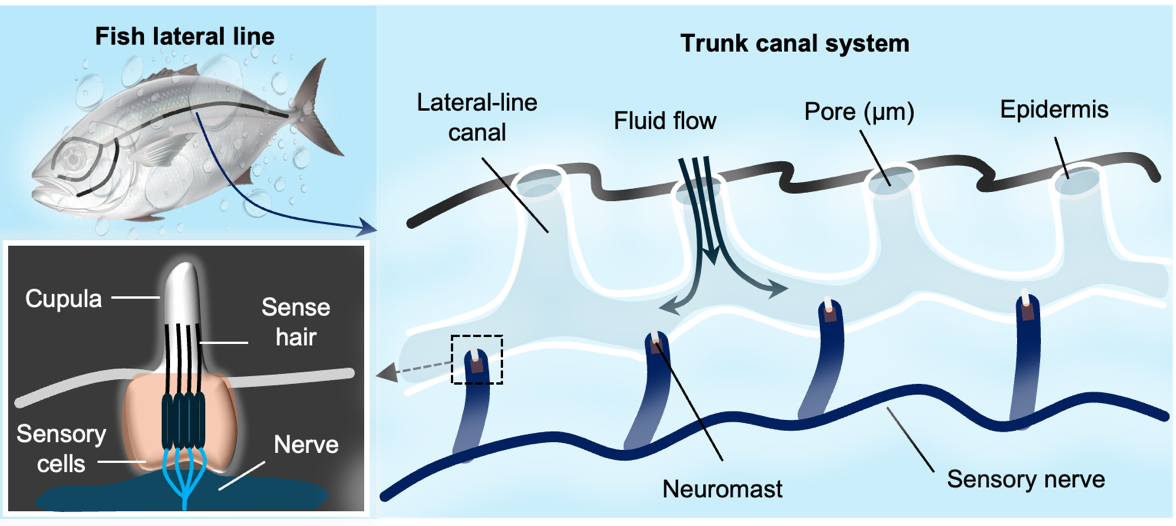
Image caption: Sixth sense: Illustration of the lateral line in fish and how vibrations and water pressure changes are transformed into neural signals and sensory information.Credit: C. C. Nguyen, J. Thorpe, D. T. Bach et al. 2026 CC BY
Image of the month
The Brain Predicts Social Interaction Before It Starts New Study Finds, published by Hebrew University of Jerusalem on 1/6
How does the brain decide to approach others? Researchers found that coordinated brain activity linked to social behavior begins seconds before movement starts. Using zebrafish, they identified a key role for the pallium, a higher brain region required for normal social interaction, and showed that animals with a stronger brain-wide neural signature were more socially engaged overall. The findings suggest that the brain prepares for social interaction before the movement even begins, and that the strength of this preparation reflects an individual’s social drive.
Read the news
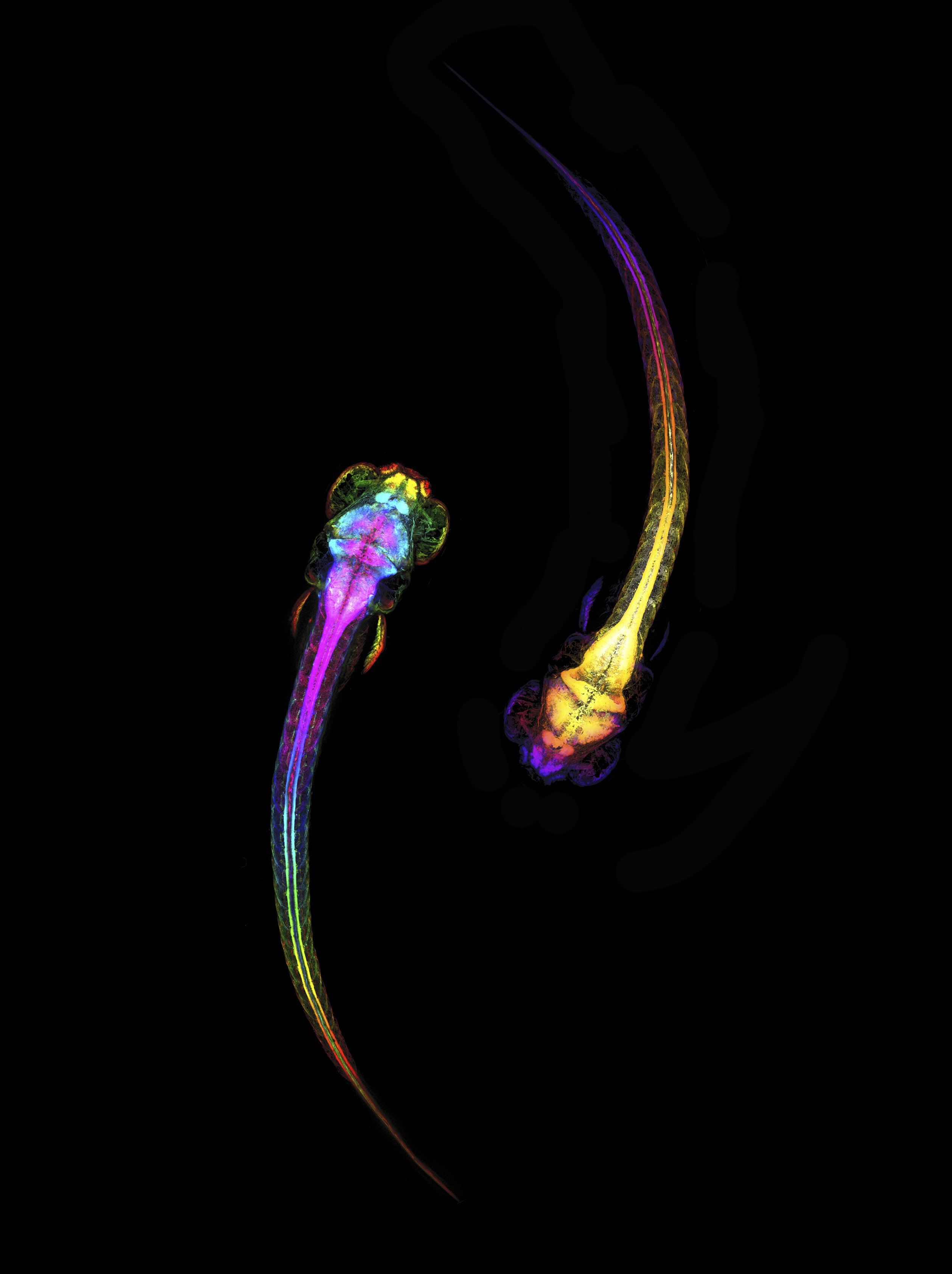
Image caption: Socializing | Description: Two socializing fishZebrafish imaged using high-resolution fluorescence microscopy; colour encodes depth across a 3D z-stack projection. | Credit: Luke A. Hammond & Jeremy Ullmann