April eNews
Welcome to this month’s highlights from last month! From the science of Tinder photos to the origins of our earliest ancestors, we’re spotlighting fresh research that explores how humans, nature, and technology connect.
This month’s Top 5 dives into how age shapes online self‑presentation, Europe’s latest food safety priorities, and the revival of old energy‑storage tech for a greener future. You’ll also find new evidence of human impacts on Northern lakes and fossil discoveries that may rewrite human history.
Our Editor’s Choice looks skyward: an astrophysics study suggesting the local Universe is expanding more slowly than expected. And in our Image of the Month, the female Galápagos yellow warbler steals the show, challenging what we thought we knew about birdsong.
If you would like to get in touch with the News Team, please email news@alphagalileo.org
All the best,
AlphaGalileo News Team
Top 5
1. Tinder and visual identity: a UOC study reveals the nine types of user profile photos, published on 6 March 2026 by Universidad Oberta de Catalunya
An analysis of 1,000 profiles shows that most of the images follow very similar patterns, blending individual preferences and social conventions. Age has more influence than gender or sexual orientation on how people show their bodies.
Read the news
2. Emerging Food Safety Risks in Europe Take Centre Stage at HOLiFOOD & FoodSafeR Final Conference, published on 26 March 2026 by EUFIC - European Food Information Council
Leading scientists, policymakers, industry representatives and early-career researchers from across Europe will gather on 10–11 June 2026 at Wageningen University & Research (Netherlands) for the joint final conference of the EU-funded HOLiFOOD and FoodSafeR projects.
Read the news
3. From compressed air to hydrogen: Europe revisits old technologies to store renewable energy, published on 5 March 2026 by youris.com
With climate change extremes disrupting wind and solar production, energy storage is becoming the lagging link of the renewable transition. Europe is going back to older technologies and re-engineering them to overcome efficiency, space, and material constraints. But experts caution: too many storage pathways still lack attention.
Read the news
4. Salmonids reveal the cold truth about human impacts on Fennoscandian lakes, published on 4 March 2026 by University of Jyväskylä
A large-scale study led by the University of Jyväskylä revealed that human activity is consistently changing the ecosystems of Northern European lakes. The study shows that hydropower and human activity in catchment areas are altering the food webs of lakes. The study challenges the belief that subarctic and alpine lakes located far away are relatively safe from human impacts.
Read the news
5. Did the first human ancestor originate in the Balkans? – New fossil shows evidence of bipedalism, published on 4 March by Universitaet Tübingen
An international team, including the Senckenberg Society for Nature Research and the University of Tübingen, has discovered a 7.2 million-year-old Graecopithecus femur in Bulgaria
Read the news
Editor's Choice
New Method Reveals Slower Expansion in Our Cosmic Neighborhood - 11/03/2026 - Leibniz-Institut für Astrophysik Potsdam (AIP)
Two new studies have measured the expansion of the Universe in our immediate cosmic neighborhood using a novel method that analyses the motion of two nearby galaxy groups within their surrounding cosmic flow. The results indicate that the local Universe is expanding more slowly than previously estimated, bringing measurements of nearby galaxies into close agreement with observations of the early Universe. The findings also suggest that less dark matter is required to explain the dynamics of galaxies within these groups than previously assumed.
Read the item
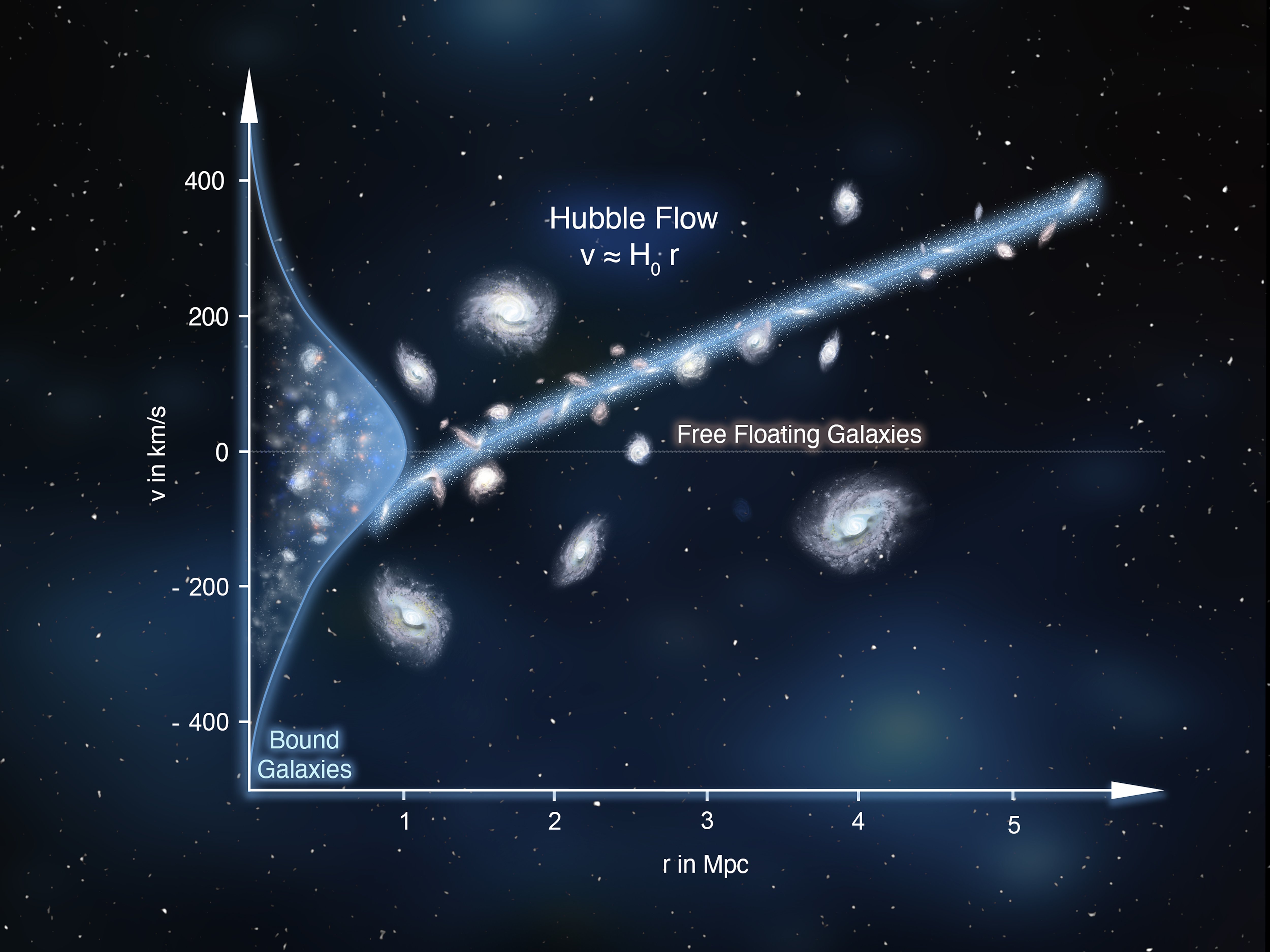
Image caption: The velocities of galaxies in groups versus distance. Embedded in the expanding Universe the attractive forces of gravity cluster the groups members together and cosmic expansion tears the outer member galaxies away. This balancing act jointly constrains the mass of the gravitationally-bound group and the Hubble constant being the expanding pull. Credit: AIP/ D. Benisty / J. Fohlmeister
Image of the month
Female song in Galápagos warblers challenges assumptions about birdsong, published on 14/3/2025 by University of Vienna
For decades, birdsong research focused almost exclusively on males. In many species, however, females also sing. Now a study by researchers from the University of Vienna and Anglia Ruskin University shows that female Galápagos yellow warblers sing frequently, though not for the reasons males do. In experiments simulating territorial intrusions, the researchers found that female song was neither linked to same sex competition nor to signalling aggression in territorial defence. The findings, published in the journal Animal Behaviour, raises new questions for the function of birdsong.
Read the item
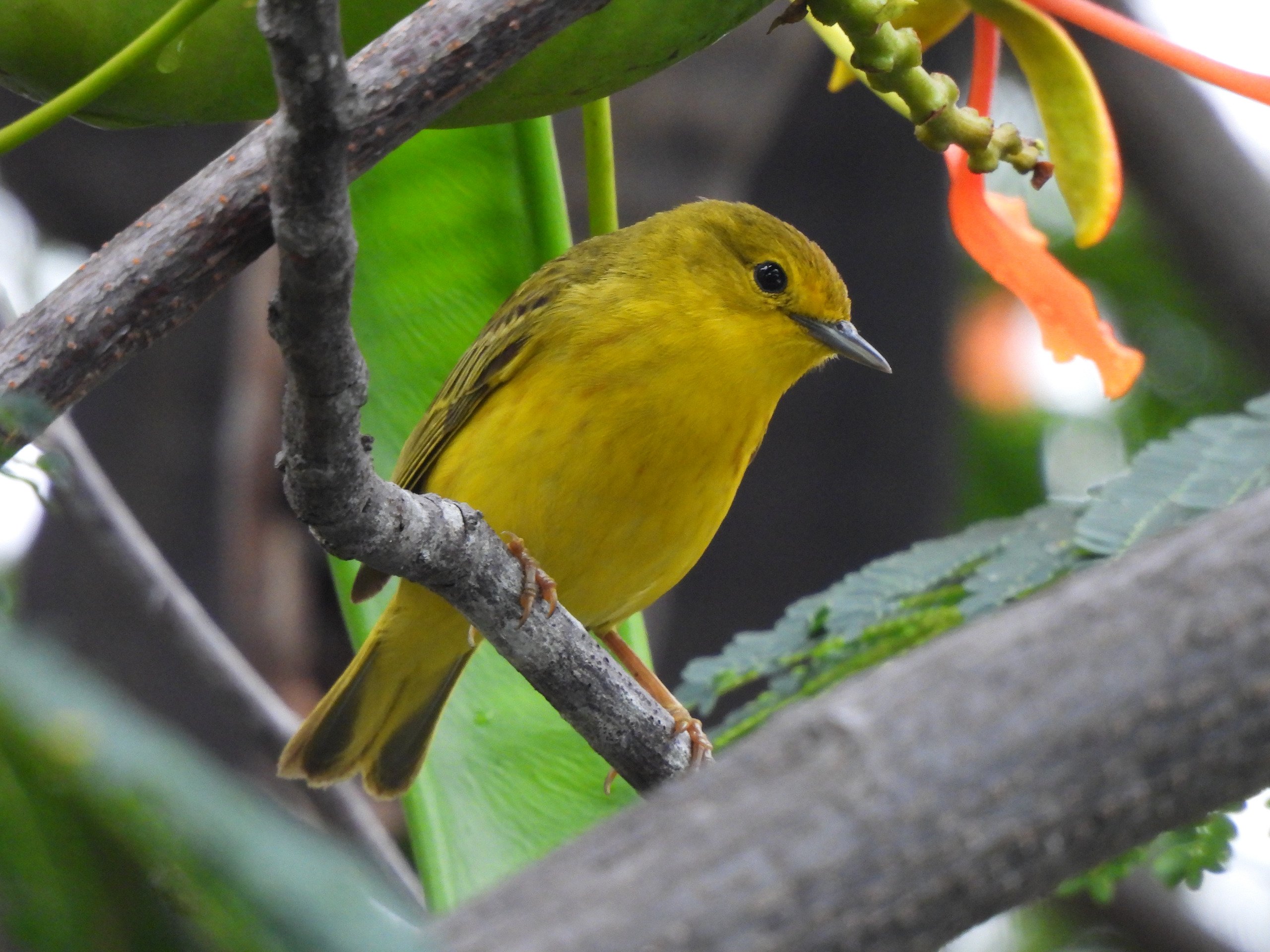
Image caption: Female Galápagos warbler. C: Çağlar Akçay